Friday, March 16, 2012

Social Graces with Dalloway, Vincent, and Others

Mrs. Dalloway said she would buy the flowers herself.

Certainly one of the most confident opening lines in literature and, after all these years, it is still one of my favorite initiations into a character and a plot. It’s a line that introduces the woman and her circumstances so effortlessly and, in a way, is the whole of the thematic character of the book in one line: Mrs. Dalloway in preparation for a party she will give – moving towards community, but also alone and intensely strained.

I have a tendency to “Mrs. Dalloway” my social scenarios. Strange - since I think of myself as someone who loves to meet new people and build small circles of friends who hug too much. I am, sad to say, a little socially handicapped. I spend vast amounts of time at parties near the cheese dip, stuffing my face and dusting broken tortilla crumbs off of my scarf, so that I don’t have to make too much conversation and thereby say one more off-color thing that proves me to be the socially inept hunchback that I am, leaving people to wonder who let me in.

Museum Night Fever
Here is this small insight into me. Perhaps I am talking to you at some well-lit party – a gallery opening in Seattle, say. There are girls wafting through the room, making it look easy to walk in heels, a band I haven’t heard of is whine-harmonizing in the background, and I am holding a glass of white wine more as a prop than to actually drink it. If I am stumbling through a story, laughing at awkward intervals and veering off the course of the conversation, or wandering dangerously close to unnecessary, blush-inducing innuendo and then spilling wine down my front, it is probably because I like you and I think you’re cool and I’m not necessarily up to the challenge of conversing with you as an equal. You’re probably either very funny or very intelligent (or worse, both). You wear a hat without looking like a poser. You’ve read more important books than I have, are disastrously well-informed about politics or the current financial crisis and I am terribly afraid that I’m about to be discovered at any moment.

Or another possibility: if I seem at all cogent or clever – if I manage not to mispronounce “endive” and don’t run roughshod with the volume of my voice, then I probably really like you and behind the steady and coyly, vague brown eyes, I am running a marathon in my head; Google-indexing everything I’ve ever learned, replaying past conversational faux pas at an alarming volume in hopes of side-stepping them this time around and wondering if you're preoccupied with the gap in my teeth.

Add the challenge of speaking in French to the mix and I’m absolutely blithering.

I’m socially useless and I know it, which means that I run at every communal occasion as though it were an episode of Survivor, wondering which round I’ll be eliminated in.

So, I am rather tense on the eave of a party – a dinner party for my small network of friends here in Brussels. I tried to buy the flowers myself, but they were too expensive. But, in spite of the nerves, in spite of the pressures I feel as a hostess for carrying off even a small party, I turned on the music, changed outfits three times and waited by the door while everyone arrived about a half hour late. Right on time for a slightly late European dinner.

Sunflowers by Van Gogh
I’ve been thinking about artists and their relationships. Probably my whole life, but certainly on this trip. Anne Lamott writes of her father who was an author, “I suspect that he was a child who thought differently than his peers, who may have had serious conversations with grown-ups, who as a young person, like me, accepted being alone quite a lot. I think that this sort of person often becomes either a writer or a career criminal.” A sentiment I agree with. Artists seem to come naturally to their own loneliness, but not necessarily comfortably. And the trend seems to be that artists are these funky creatures who are both in reverence for people and humanity on the whole and astoundingly lonely at the exact same time. Or maybe I just want to imagine better, awkward company near me at the cheese dip.

In Amsterdam, Kevin and I visited two museums. One was the Van Gogh museum, which thoroughly secured Van Gogh’s place in my heart. The whole experience is set up chronologically – shepherding tourists through his burgeoning impulses to become an artist into the full-fledged effort that he throws himself into in his early years, encouraged largely by his brother Theo, then on to his tours through France, Belgium, and Holland sampling different countrysides, colors, and landscapes along the way.

The museum, in this way, is also somehow a story of not only Van Gogh, but his brother who loved him so dearly – to their deaths, so close in proximity to one another. It turns out that much of Van Gogh’s acclaim is owed to Theo’s widow who felt honor-bound to earn Van Gogh his acclaim after both of the brothers had died, since their wish for his success was a shared passion.  It becomes clear as you walk through the work that much of it wouldn’t have happened without Theo encouraging him, without Theo to write to as Van Gogh tried to explain and hone what he was working on, without Theo to berate for not better advocating his work, without Theo to hearten him and tell him that he truly believed in the work he was doing.

Wheatfield with Crows by Van Gogh
I saw some of Van Gogh’s sunflowers which echoed my experience of seeing them in the National Gallery in London a month ago, bringing some amount of unity to the widely-flung net of my travel. I walked along his wheat fields, forests, still lifes of fruit, and looked at the grimly set faces of the Potato Eaters, admired blossoming trees, strolled along his garden paths and watched the world turn to whorls of water under Van Gogh’s paint brush. My favorite painting ended up being “Wheatfield with Crows,” which is supposedly his last piece. I didn’t read more about him until later that evening when I again had internet access (thanks, Wikipedia).

Self Portrait by Van Gogh
Never married. There were several women that he confessed his love to that refused him, a prostitute that he lived with for several years along with her two children. He had a professional fixation on Gaugin and was obsessed with the hope that Gaugin would someday view him as his equal (which never really happened). And then, as his mania reached a fever pitch, he went to confront Gaugin with a razor, thought better of it and went to the arms of a prostitute at a local brothel named Rachel where he cut off the lower part of his lobe, gave it to the prostitute and told her to bare the package carefully. Then hospitalization, cloistered experiences that still yielded paintings, and then, at the age of 37, he ostensibly shot himself and died two days later with Theo at his side. Another theory goes that two boys in a field shot Van Gogh who they knew to have a gun, though this theory seems to not be recognized by the Van Gogh museum. In any case, the gun was never found and Van Gogh’s last words were “the sadness will last forever.”

I’ve since been reminded by a friend of a book called Dear Theo, which is a collection of the correspondence between the brothers. I plan on reading it myself, but what seems most clear from my friend’s description of it is that Van Gogh wasn’t a raving, talented lunatic. His letters instead reveal that he is a complex, feeling, intelligent, troubled, and oftentimes lonely person. And, according to the museum and those letters, in spite of that loneliness and feeling of inferiority, so often what he wishes to express in his art is connection, reassurance, and hope. I think this desire comes to artists because they feel some gap between themselves and the rest of the world and are simply trying to build a bridge over it. Maybe everyone feels this way. I don’t know.

Otto Frank at the Anne Frank Museum
Kevin and I also visited the Anne Frank house in Amsterdam, which effected me more than I thought it would. I hadn’t realized that it would be so hard on me (after not having read the book for such a long time), to visualize Anne Frank growing up here in this cage and then enter that final room knowing that she died of Typhus just a month before liberation and just a few days after her sister without any of her family left to mourn her (except her father, years later).

The museum takes you through the two stories of the secret annex and is completely unfurnished. It is an interesting choice meant to honor the wishes of Otto Frank who said that he wanted the museum to stay exactly as it was after the raid that exposed the family. Purely on a practical level, I don’t know how people would get through the place if they moved any of the furniture back in – there would be no room for maneuvering and the flow of traffic would be like the 520 highway between Bellevue and Seattle at rush hour. But, on another level, the empty rooms that were once her entire world communicate another sort of sadness, that isolation from the rest of the world that Anne describes in the book – something that I’m sure Otto Frank hoped would be implied. Even as you squeeze between the shoulders of other backpacked tourists, trailing curly-headed kids behind them, there is something inherently lonely about those rooms.

Whoever betrayed the Frank family was never discovered – the anonymous tipper remains anonymous to this day, in spite of extensive investigation. Which left this hollow ringing in my stomach as I thought of her while we exited the museum into the unreasonably pleasant sunshine outside. As someone who so desperately wanted to be a part of the rest of the world, I wonder what would have become of her book if she survived, what sort of writer she would have grown to be.

Amsterdam's Homomonument
So even though the sun was beaming as Kevin and I stopped by the nearby Homomonument (a large pink stone triangle in the center of a square, placed in honor of all those persecuted for their sexuality), I didn’t feel light and giddy in the spirit of Amsterdam, as I should have. I felt weighted, tired, and more reflective than social.
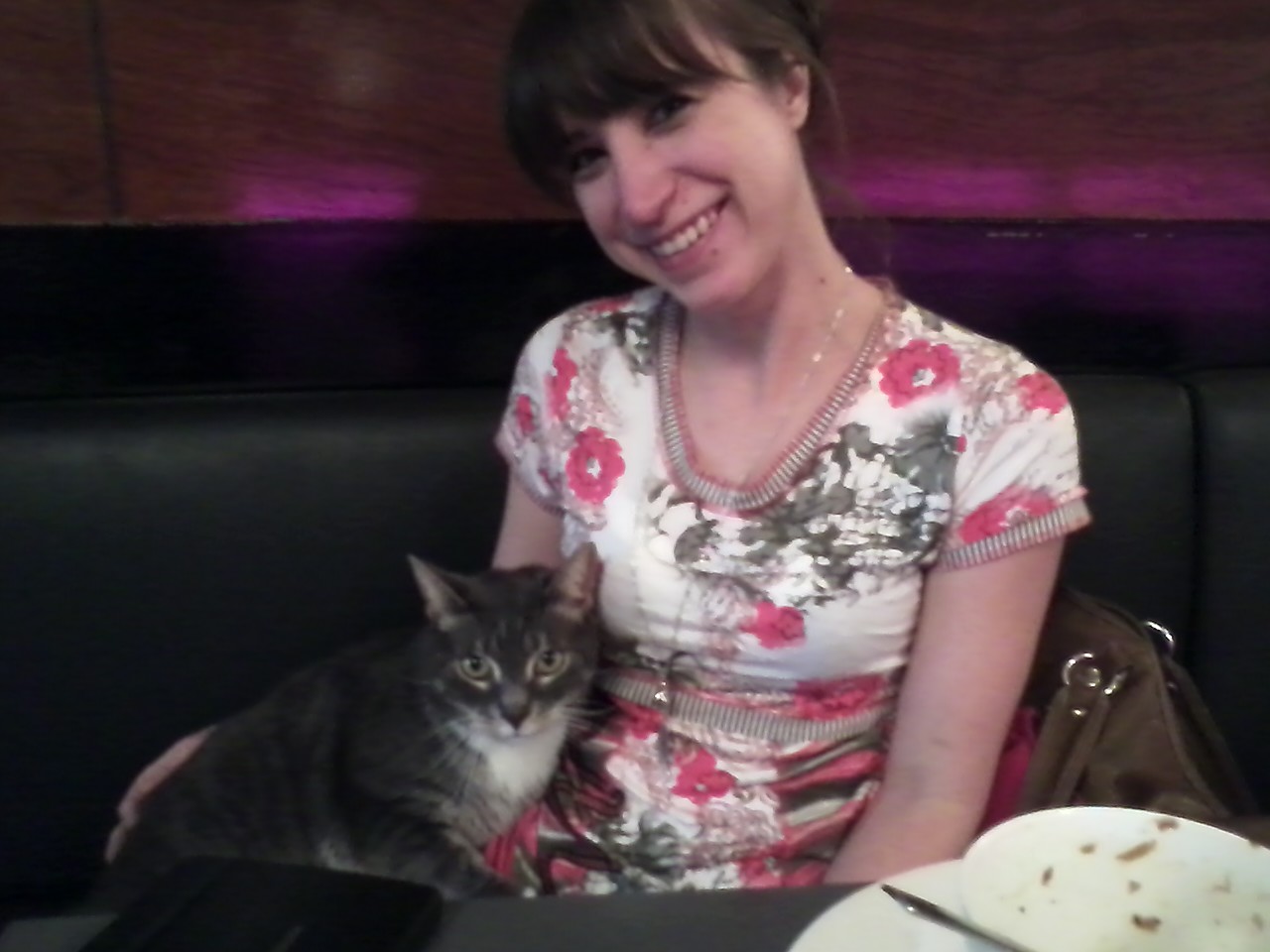
Kitties will Save You From Despair
We stopped at a café called Walem and ordered a soup for me and a sandwich for Kevin, while we discussed plans for tonight, the order of operations for stopping into different night clubs, what we should wear, etc.  But the conversation was slow and half-hearted in a way that isn’t the norm between Kevin and I. As we ate lunch, a gray cat wandered through the cocktail tables and scratched on the wide-windowed back door of the restaurant that looked out over a terrace. The tall, balding, and well-assed waiter opened the door and went about clearing more dishes from the lunch rush. By the time I was at the bottom of my Diet Coke, I still had that lonely, hopeless despair rock in the center of my stomach thinking about the distance between Anne Frank and the rest of the world and was just about to ask for the check when the restaurant’s gray cat wandered back to the high bench I was sitting on, leapt up in one coiled move and settled onto my lap. And even though nothing had changed, even though I could still hear Anne’s father’s voice from the video at the museum’s finale telling me that he was not sure that any parent could really ever know their child, as I stroked the soft gray furry back while marshmallow paws gently kneaded my stomach, whatever sadness I was suffering as I pondered the human condition gradually melted away. I ordered a coffee and Kevin and I sat there gazing at each other over the lunch debris, smiling.

Along the Rue des Bouchers with Kevin
It is a good thing to have another writer alongside you as your companion. What is so often a solitary activity, suddenly takes on a new form as you and your friend settle in front of your respective machines and begin to clack-clack your way through an hour.

When we are out together in one another’s company, Kevin and I, we are often mistaken for a couple. We walk joyfully arm in arm and the two of us take turns sometimes resting our head on the other’s shoulder. On our first night in Amsterdam, in one of the city’s oldest coffeeshops, Bulldog, Kevin and I met two very nice older gentlemen on a one-day layover in Amsterdam. One was a ship’s captain, the other – a chief engineer. Kevin clarified “so you’re Jean-Luc Picard and you’re Geordi La Forge?” The two guys loved it and roared with laughter. “You’re right,” they said, slapping Kevin’s shoulder, “that’s exactly right.”

They bought us drinks and talked to us while we settled into the feeling of the city. They were both interested in us being writers and were glad to talk to us about it: why we liked it, what books we liked, what we were working on. When I left the table for a moment, the chief engineer turned to Kevin and asked “is it hard to date someone that you have so much in common with?”

Then the explanation that has followed a few times on this trip: no, we’re not together, we’re just good friends, he’s gay and we’re both single. We’re just here on an adventure together.

At SOHO in Amsterdam
And somehow giving the explanation is both an invitation to remember how single we both are, but also oddly comforting. Kevin looks at me and I look at him and as the chief engineer asks “well, then, do you have a boyfriend?” Kevin replies with the most subtle of sighs, “I just think it takes a long time to find the right person.”

And so it goes. Keats on his death bed saying that if he could only get well again, he would go back to England and convince Fanny to marry him. Jonathan Swift’s final wish to be buried next to the woman he had loved for almost her entire life. Van Gogh struggling against his sadness until the end as his brother held his hand while he died. Me, writing in my silly journal, scribbling away at my silly book and shelving my nerves for an evening to give a small dinner party. Because in spite of my nervousness, I rather like people, so I’ve found something really wonderful in writing. There are no shitty first drafts in the improvisational art of conversational charisma. But give me a word processor, several days of editing, copious cups of coffee, a dictionary and fact-checking capabilities and I might emerge from the experience with a whole person (either myself or an imagined character) that can manage the interaction. I can speak to you this way. Or at least try to.

So there we were, finally seated around the dinner table. A – my Italian friend who studies law, who inspires me to fearlessly say “yes” over and over again. She, of all the people who were to come to the party that night had the least amount of English, yet throughout the entire evening she participated in the conversation, asked to be corrected, and laughed loudly as we covered a range of subjects from public urinals to the fashions for tying scarves. So far, she has not once said "no" to something I've invited her to. My new friend, S, who arrived with both appetizers and desserts and was there by my side in the kitchen while I cooked offering advice and telling me funny stories and who didn’t know a single other person in the room when we sat down. R - who is always fashionably dressed was there with her handsome boyfriend, eating their way through their second, long meal of the day. L – a lovely, young German woman who lobbies for the organic produce industry and is constantly apprised and letting me know about interesting things that are happening in the city (like Museum Night Fever or the concert that is happening tonight that I will be attending with her). F – neighborhood actor and English teacher who I met on the tram. And Kevin – certainly the life of the party who sits down opposite me at the head of the table, each of us taking the position of matriarch and patriarch of the feast. We laugh all night long and yes, everyone does indeed stay for coffee. 

I’ve been asked several times throughout the course of this trip (more than ever before in my life, really) why I write and I find that in spite of having a buffet of reasons to select from, I tend to trip through all of them simultaneously and somehow end up poorly quoting portions of my favorite childhood novel, Watership Down – ending by finishing lamely “well… so… rabbits… as a metaphor… powerful stuff.”

But let me try to organize myself a little better here. I write, because it is the only vehicle for connection that I have found that I can drive with some degree of skill. I write to try to communicate with you, with all of the books and authors I’ve worshipped along the way, or yes, with myself, as well.

Bike Ride to Tervuren
I think I am interested in the lives of lonely or awkward artists, because it is the aspect that I most identify with. The sense of displacement, but also a sort of reverent love for the people around me. And well, the only weapon I have to defend everything that I’ve ever loved, never had, imagined or hoped for is my keyboard so that I can tell you about all of them. I can tell you that there is a woman I know with a view across the city who loves a gardener that she has known for ten years, I can tell you about a downy-blond dog in the park the other day who waggled his tiny butt when he saw me and and then shied away back to the knees of his rosy-cheeked, spectacled master, I can tell you how good it felt to ride a bike with my friend while the bike seat somehow shifted off its axis and I laughed as I almost tumbled a dozen times into the thorns lining the road we were on. These things happened. I can tell you that they did. And if I can tell you that, maybe the distance between us isn’t such a large gap to cross after all and maybe I’m not the only one by the cheese dip. Maybe you’re here too and we can both make our way through the conversation together.
...

I went to Amsterdam, stayed out late celebrating Kevin’s birthday, met new people, stopped at a bar that looked like the library on Titanic, toured through the red light district, bought more chocolates (also watched a whole lot of Downton Abbey), gave a dinner party, wandered Vondelpark, stopped for a drink at my friends’ place overlooking Brussels, visited churches, convents, and karaoke bars. I should have written about the canals, the views, the food. Instead I wrote about artists and writing. Ah, well.

In fact, I have written about all those things – just not here. If you would like to hear more about adventures in Amsterdam  or my attempt to make friends with a  goose, please email me – I’ll send it along.

Monday, March 5, 2012

Night Fever

Me in the Parc Pépenière, Nancy, France
I woke up alone that morning in a strange bedroom with my back pushed up against a wall after having slept on a fold-out futon with a sizable divot at its center, that I was tacoed into. I’ve been traveling through the European countryside with my mother, her husband and their friends. In their company, I’ve seen Place Stanislas: the small, guilded city center of Nancy and wandered along the canals of Bruges. We’ve had several family dinners in well-lit restaurants or fireside in a farm-style ranch near a rolling hill in the French countryside where I can hear sheep bleating in the night. We’ve toasted with several different white wines, champagne, we’ve laughed at my tripping French and I’ve gleaned from the wheat fields of my mother’s well-traveled friends several short story ideas. This morning, I’m waking up at 6 a.m. to ride from France back to Belgium.

The bedroom is cold. The blankets are bunched up under my chin and I’m pillow-creased across my face and disappointed at how misty 6 a.m. looks between the slats of my window.

I’ve been waking up alone for almost thirty years now, the thought occurs to me.

It’s a five hour drive to Bruges in the squat blue rental car that my mother and Michael rented. The time passes quickly enough with my mother repeating all of the GPS instructions to Michael as we go. There’s me; in the back seat awkwardly typing on my orange-juice sticky computer, visible to Michael in the rear view mirror, and my iPad is the backseat DJ.

Me and My Mother in France
In the backseat, I can spread out, write, read, and (when I want to chat) I can lean forward to stick my head between the driver and passenger seats during conversation (which is always fun). It also feels very much like being a little kid again. The grown-ups paying for the gas, the food. The grown-ups who, after having found each other and figured out how to live together, keep a house together, and take intercontinental vacations together, squire me about on my European experience. And as I look at their paired profiles in the front seat and then look over to the listless seatbelt in the vacant seat across from me, piled with luggage at its feet, it seems as though there is an implied absence.

View from the Hotel in Bruges
Right now (as I write this) I’m here. In Bruges. The canals carry sound in strange ways across the courtyard so that as I’m outside by the waterside gate it sounds like the boy careening home drunk on his bicycle in the middle of the night on the street outside is actually going right past my ear. The water is mostly still, just slow, gentle eddies as a duck dives into the water for a midnight dip or a swan goes to take another lover. This is Bruges by night, but first there was also Nancy by day.

I have actually been to Nancy, France before when I was in my Senior year at Epping High School, although it turns out that most of the memories have been white-washed over or transposed into watercolor, because seeing the city now as someone totally enamored by nothing more than food, architecture, and art (rather than the intricacies of the high school relationships of the thirty other people that I was traveling with then), I am in love with Nancy – a city in the Lorraine region of the French paysage. It all seems very new.

Place Stanislas is a wide-open square that made me squint even in the initial gray afternoon light. The square is bordered by darker stones and then the rest are these bright ochre stones which pave a pedestrian only square for festivals, cafes and other city events.  As the fountain of Neptune pounded away in the background we walked past the Hôtel de Ville, the Opera House, the Museum, my mother ducking into the tourist shop. And then (right in the center) is Stanislas himself. The gray monument capped with his statue peering through the Arc de Triomphe by Héré  leading to the adjoining Place de la Carrière reads

Place Stanislas in Nancy, France
Stanislas Leszczynski, King of Poland, Duke of Lorraine and Bar, 1737–1766
To Stanislas the Benefactor, Lorraine is grateful, 1831, Meurthe-Meuse-Vosges

What was the king of Poland doing in the middle of a square in France almost 850 miles away from his home? I wrinkled my nose and asked my mother’s friend, an English teacher here in France.

Well, she tells me, Stanislas, twice the king of Poland ended up having to abdicate the throne for a series of reasons, but after his abdication in 1736 he settled here and was named the duchy of Bar-le-Duc and Lorraine and during his time there he was noted as a good host, a patron of art and science and the architect for the idea that eventually became Place Stanislas, uniting both the old quarter and the new quarter of Nancy. A good man, apparently, and partially responsible for uniting the Lorraine with the rest of France, father-in-law to a queen, overall well-remembered. Not bad for a foreigner living in another country.

But apparently in his old age he had become particularly enormous, boasting an untenable rotund fat body that he hauled around on his 89 year old legs and still it wasn’t old age that did him in. One night, going to stand by the fire after dinner, he lost his balance and fell into the flames and although his skin was immediately seared by the heat, he could not right his enormous body and instead flailed about as he burned, doing little more than rolling around in the embers. Help arrived, summoned by his screams, but not in time. He was seen to by a doctor immediately, but it wasn’t until four days later that he died in great pain from those burns.

Place Stanislas in Nancy, France
These are some of the things I learn while traveling…

My skin, almost 250 years later feels sympathy pains. I look up at his flowing robes, the confident hand resting on the hilt of his sword, the other pointing to the North and I wonder if a former king who died in flames knows that I’m wondering if he was ever in love, if he cared about his children, what music he appreciated.

Le chat noir in the Window in Nancy
The old quarter of Nancy was also bright, peopled with almost as many statues in its walls, alcoves, and alleyways as it was pedestrians. By the time we finished lunch along the Rue des Gourmands the sun was properly shining and all of the cafes had come alive with people, reading, smoking, laughing and talking in rapid-fire French in high spirits, probably encouraged by the springtime-promising sunlight. In one of the lacey-curtained windows of one of the shops along the way, a humorless black cat watched my progress across the street with gray-green eyes and flicking bottlebrush tail. I stopped to look at him, each of us evaluating the other and his tiny butt shot into the air, ready to pounce through the layer of glass separating us if necessary, when I took a step towards him. I ran my fingers all along the panes and he chased my hand.

Chez Ablancourt
Later that night, back home with the Ablancourt clan, I stepped outside while my mother and her friends were talking about the qualities of French vs. American elections. In the dark, back at M’s place in Flavigny, the mountains were one long low, hulking shadow and the air was almost warm. Little solar lights lined the stone walkway to their house where I sat on their stoop, afraid that I had locked myself out. The whole world smelled both funky and natural: like camembert cheese and rain.

And for some reason, in spite of the fact that I have spent the past week in the company of a shifting group of wonderful people that I love very much, I also felt very alone. 

Thinking about kings burning, reading poetry by Cavafy, listening to too much Dylan and seeing old acquaintances that knew you way-back-when, sometimes it all leaves you gasping for air when you’ve put it all together in combination. And it makes you feel a ghost in the air around you – of the person that you haven’t yet stumbled upon that makes the poetry, shifting ground, food, and hard historical stories make sense yet in the context of your own life.

Boat Tour in Bruges
Here is a story. Thomas Hardy, author of some of my favorite novel-length heartrending catastrophes, was 30 years old when he met his wife, Emma. They were married four years later and the marriage lasted until her death in 1912 (thirty-eight years all told). He was a 72-year-old man at that time of her death and she was buried on a shady stretch of green in Stinsford parish. He was a notably published author at that point, estranged from his son, and re-married to a woman 39 years his junior and all he could think about was the wife he had lost.

He wandered around Cornwall where they had met years earlier when he was studying the architecture of a local church and wrote poems about their young love nearly forty years after it had all gone away and even though he was to be honored after his death by being buried in Poet’s Corner of Westminster Abbey, the family insisted that he be buried next to Emma in Stinsford Parish. To this day his heart is buried in Stinsford while the rest of his remains are housed in London’s Westminster. Poems like “Without Ceremony” and “At Castle Boterel” are about the merciless forward movement of time, especially when it comes to maneuvering us further away from our love.

I think, no matter the height of our career, the joys of our travel, the pleasantness of the company that we’ve kept along the way, sometimes we are helpless, soppy poets when it comes to missing lovers we’ve lost or the love that still has yet to arrive.

I wandered around Bruges noting the cozy, two-person tables inset into the walls of restaurants overlooking the canal with champagne buckets nearby, the couples pawing at each other by the lights of the fountain in the park, the blankets draped over the edges of the horse drawn carriages as invitations. Bruges is an old city, romantic for its architecture, living and breathing stones, and flowering crocuses all around the borders that are still marked by windmills and connected to the rest of the world by bridge.


In fact, the bridge that my grandfather stopped to paint in Bruges over 40 years ago is still there and along the inside lip of the bridge there are little dangling locks that are meant symbolize the steadfastness of love. The Love Bridge or the Wedding Bridge leads over the canal, away from a church into the center of town and is still used by blushing brides today as they take their first steps into their married life.  40 years ago, my grandfather sketched out a painting alongside his friend – both men charmed by the romance of the arched pathway, the moist springtime air. I picture them seated on the low wall along the path leading from the church with berets on (thought it is unlikely that either of those men ever wore a beret) eyeing the bridge as one couple after another walked through their line of sight to kiss at the bridge’s midpoint. And in spite of the traffic that they must have seen, the painting that hangs in my grandfather’s house is un-peopled, leaving me with a sense that they saw the bridge more as an invitation to lovers than an exposition of lovers.

Anyways, these were the thoughts that I was carrying around with me on Friday. Someone was suddenly taking her time abroad and herself far too seriously, and I’m not sure how long I would have stayed on that course, but by that evening it was time to put on my new dress and head towards Le Bouche à Oreille to hear Charlotte Deschamps in concert.

Which, it turns out, reminded me what this whole grand mess is actually about.


Charlotte Deschamps in concert is a grand pleasure. A mixture of old cabaret-feeling performances with poetic ballads and other cheeky, clever little larks of song. I had my flip camera at the ready and was glad to capture a song called “Les Filles de Woluwe” (a song about the girls in the neighborhood that I live in). From my seat among new friends ranged in the chairs around me in the dark, I watched someone blissfully talented enjoy performing her art for a group of enthusiastic patrons. I smiled and laughed interminably throughout the whole thing even though I missed much of the all-French lyrics. The whole audience cheered the entire song list that was followed by several encores and featured some brilliant original musical composition by Charlotte’s friend.

Museum Night Fever at Bozar
And I followed it up the next night with a similar surprise Brussels pleasure. I learned that Saturday (after Kevin’s early morning arrival) was actually a special event in Brussels in which all of the museums in the city open their doors until one in the morning and transform themselves into concert halls, dance clubs, poetry slams, and live performance venues, complete with lounges and participatory graffiti. It is a special event hat happens once a year called Museum Night Fever. Kevin, shouldering his jetlag rather well, took to the late night challenge amiably and only hallucinated a dragon once (which, considering the substance of the evening, was really quite a credit to him).

There we were in the Musée des Beaux Arts with about four hundred other people ranged along their marble steps watching a howling band play while two other girls danced interpretively in long sliding steps all around the middle landing (planned or unplanned, who knows?)

“So the Heroes are actually really big in Brussels?” Kevin smiled as we watched the interpretive dance and accordion playing shift into a heavier metal band. I punched him in the arm.

Bozar at Museum Night Fever
Brussels, usually so quiet, was fired with spontaneous art of every kind last night. 24 of the city’s museums had transformed themselves and in every corner of the city, people were touring the galleries while listening to rock music, participating in a flash mob (or a silent mob – that was an option, too – but I don’t know what that is), or watching stringed quartets.

When we entered the Grand Place to go to the Royal Museum an enormous red box had been plonked down in front of it with large white words written in Flemish across its front, a bull horn was placed in the artful cracks through its side and someone was shouting poetry. As a group of loosely affiliated foreigners, we saw a great deal of the art of Brussels in one evening and the shift in my attitude in the face of new art was palpable. And it definitely helped to fuel the six hours of writing this afternoon. It’s funny the way that art can change the face of a landscape, can change the way you think of yourself in that landscape, can make you un-know yourself a little bit. It can leave you feeling unglued, but it can also remind you of the possibilities of the life you do not yet know, instead of the hall of doors that all seem to be shut.

The thing is - the aloneness, the time spent apart from all the rest of the business of life, well, I guess that feels right to me. What do I love about this damned writing thing? The answers to that seem to be multiplying. And they are questions whose answers have only come in company with a small touch of isolation. So maybe knowing who you are is overrated. And maybe romantic love is important, but maybe its absence shouldn’t live so near to the center of a wounded heart. Maybe assigning a value to anything isn’t really a key to discovery at all. Maybe just long walks, good music, passionate practitioners of interpretive dance and really, really amazing chocolate are the actual keys to self-discovery.


Tuesday, February 14, 2012

In the Company of Cats and Chocolate

I keep my company with a cat these days. This rusty-black German Rex cat with one cloudy blue-grey eye. He lives in the shed next door. Each day, after lunch, he stalks by the front stoop, grizzly and damp. He comes up the short walkway leading to my door on his way around back with taut, coiled steps. Once he is within swiping of distance of me, he pauses. Every muscle rigid, almost vibrating while he evaluates me. Perhaps of all animals, cats have the ability to glare. But this shed-dwelling sovereign exceeds all average feline standards. He is downright livid at me for bearing witness to his afternoon cat errands. At some point, he moves on with a authoritative “I pardon you” and tumbles in a graceless plunge through the shed window. He is my only company and he hates me.

Trinity College, Dublin
The truth is that, for the moment, I am more alone than I have been a considerable amount of time. Just me and the cat. The days arrive gray and rainy with a very vocal wind. The winds seriously shrill here as they run up the gabled, tiled roofs of the neighborhood. The windows buck against their frames and the bare tree branches are tiny chutes of sound that the wind barrels through in long hissing arcs.

While talking to my mother one day, she could hear it in the background of our conversation.

“What is that?” she interrupts herself mid-sentence.

“It’s the wind, I say. Don’t worry. It sounds worse than it is.”

“Do you remember,” she begins in that way that reaffirms that I’ve forgotten important lessons from French class, “that the French have different names for the winds. They’re supposed to have different effects on your mood. The way they say the Santa Anas do.”

I don’t remember this. And haven’t heard this. But it turns out that yes, there is a wind in France called the Bise Noir which is said to drive villagers mad. Something I am certainly at risk of here a bit – tucked away in front of the computer screen sprinting through as many chapters as manically as I can.

Someone recently shared with me the blog of a woman who chronicles her solo travels. For Valentine’s Day, another blog enumerated the benefits of being single and abroad as covered in this woman’s posts. Among them are the lack of itinerary, the ease with which you meet other people, excitement, newfound confidence, and the ability to forge lasting connections with those that you do meet.

The observations themselves aren’t revolutionary, but they certainly seem true. Which means, that yes (even besides the cat), I haven’t been entirely alone.

Molly Malone, Dublin
On my last night in Dublin, I had no hotel. This was an intentional maneuver since my flight was somewhat early in the morning and I knew that some Irish pub would surely be showing the American Super Bowl. I figured I would save a few Euro and just stay up late. After several hours wandering Dublin by myself and dinner at an Indian restaurant where a group of Welshmen (flush from their win that day) invited me to join their conversation, I ended up finding a pub in Dublin’s Temple Bar promising seven screens of Super Bowl viewing. I went inside and leaned against a cocktail table by the nearest blue and white Tom Brady jersey that I could see, dubious about my Patriots during that first quarter.

The game was going badly for my team and I think I was scowling a bit, but a fresh-faced and cheerful looking Irish boy looked over at me: “Patriots fan?” he asked and I nodded and he pulled me up to his table with one arm and said “Aw, come here.”

After that, I felt very much at home with some ardent Dublin Patriots fans. We pumped our fists in the air at touchdowns and, at other times, stared fixedly at the TV screen willing the scores to change when things took a turn for the worse. Between quarters we smoked cigarettes out front and the Irish Patriots fans asked me questions about my book, one of them admitted to being a poet and a human rights advocate, the other, an engineer. We talked about New England and we talked about football. In the final hour of the game, no one was allowed to leave the bar and we sat back-to-chest and shoulder-to-shoulder watching those last few yards between the Giants and touchdown close dismally one by one. I watched them score and with a minute left in the game, I held my breath for every play until the Patriots finally lost.

As we wandered out onto the street, we slung our arms around each other and let loose some commiserative moans. For another few minutes we stood there, talking, laughing, and finally getting to the point in the conversation where we exchanged Facebook profile names with promises to find each other eventually. And so there – the first friends that I made as a solo traveler (if you’re reading this now – Hi Peter and Seamus!). I felt very sad to leave and I looked back over my shoulder several times at their small knot of bodies still groaning over the loss as I walked back to my hotel alone at three in the morning to fetch my bag for the airport. Funny how being alone after being so thrown together in such solidarity with other people (even with strangers) leaves one feeling even more isolated, quieter.

I said I wasn't going to post this picture
of myself... but it reveals too much truth...
Then my first week of French class, writing, shopping and long hours at the writing desk that this lovely family installed for me. I keep the heat low throughout the house, wear my fluffy blue bathrobe, sometimes doubling up on scarves. With just my little head visible over the top of my robe, I look a bit like a bloated, fuzzy Smurf.

Which is why I decided I needed to leave the house on Friday night. The problem is that it is very difficult to leave the house when it is so cold. There is no new snow, but the little that has fallen (nearly two weeks ago) dusts about in small piles and refuses to melt. Even when the sun blares all day, the wind and the hard temperatures are only enough to make tiny dunes of the thin sheet of flakes that cover my little back yard.

Café des Halles, Brussels
Anyways, I put tights on under my jeans and waited for the late night tram to take me into the heart of downtown. On the way to the bars by the Grand Place, I walked through the Rue des Bouchers where a young, dark-haired man wearing a chef’s vest stopped me and referred to me as "princess" throughout the conversation. I paused in that blue and green lit neon walk for a moment to talk with him (what minute can't I spare when there is literally nowhere that I have to be). He brought me into the restaurant that he ostensibly owns and gave me a glass of champagne and then took me outside to the heat lamps, produced an ashtray and we smoked together. When I said goodnight, trying to make a graceful exit out of a lie that I have to “go meet a friend,” I headed towards an area that Bri and I visited two weeks past and find a bar that claims to be part café, part dance hall, part art gallery and find that it is indeed a lovely venue.

Café des Halles, Brussels
It looks like a converted railway station with high sweeping iron beams that hold up the domed roof. The walls are brick with intermittent columns supporting the three levels that wrap around the whole room. There is a fountain at the center of the room as well as a sweet-looking DJ who I glance at throughout the evening. My young-looking server is charged with the sad task of conveying notes on pieces of cardboard boxes from a gentleman at the bar that I never quite see that gives me his number with scribbled Sharpie messages in French. He sends me a drink and later on a genial New Yorker takes a picture of me and ends up telling me about San Francisco and himself. And despite the trip out and the pleasant conversations, I still feel rather lonely. Not at all the Irish camaraderie I had so enjoyed less than a week before. But without an itinerary, agenda, or anyone to answer to, I was able to select my chances for myself. I treated myself to taxi home and jabbered with my driver in awkward French. That counts as practice for French class, right?

My benefactors here have a daughter that lives in Brussels and after a few missed connections, we had finally made a date for Saturday afternoon. And despite the cold, we decided to spend the afternoon taking a walk around the pond in the Bois de la Cambre.

Bois de la Cambre, Brussels
Charlotte, tall and willowy with wildly bright eyes, is an actress, comedienne, singer with a concert coming up at the beginning of the month. As two wool-wrapped artists on our own for the first time, we ended up going over a lot of our troubles with art, our giddiness for it, the personal trials associated with it. At intervals she would point things out to me: a red-throated robin, blocked off areas of the ice where skating was forbidden, large rock archways, and the small island at the center of the pond. She gently corrected my French as we walked. And even though the wind had bruised us blue by the end of it, I was surprised when I looked at my watch and learned that we had been talking for nearly two hours. We ended up in a café with our hands cupped around two warm bowls of carrot soup accompanied by thickly sliced bread and small flowers of butter.

Chez Charlotte, Brussels
Afterwards, we went to Charlotte’s place with a brisk walk along the sidewalks of Brussels, peopled with families out with strollers and men with their newspapers and girls with high boots. Her apartment is in an old town house style that would have once housed only one well-to-do family, but is now split into three floors of one bedroom apartments and the whole thing begins with a high and green-as-grass front door. We go up two flights of stairs and arrive at Charlotte’s apartment which is the ideal artist apartment – tastefully decorated with antiques, cards from friends and flooded with light from the high windows. I look across the street at all of the other buildings in the old Belgian style standing at attention, shoulder to shoulder and wonder how someone couldn’t be inspired here. I imagine that every flower box at every window along the street is the home of a poet, sculptor or dancer. And we continue to talk all afternoon long.

Is there anything better than making a new friend? Meeting yourself again for the first time and wondering what you might look like as you puzzle over an unknown French word? It is perhaps the greatest joy of traveling by yourself - you find out not only who other people are, but who you are as you get to know someone who has absolutely no sense of your past. You carefully unpack yourself for the first time in good long while and find out what you're really carrying around with you.

And so I find myself alone this Valentine’s Day. And yet, untroubled by that fact. Even with the Bise Noir blustering outside my window.

Full-size Chocolate Orangutan, Brussels
(I think the only thing that would make the Belgians
happier is if they could have made it out of beer)
This weekend, I also visited a chocolate shop with another friend – the premiere artisanal chocolaterie in Brussels: Pierre Marcolini. Of their highly varied selection (saffron, violet, rose, anise) one of their offerings is a tour around the world in a box – through chocolate. Each tiny truffle represents another country: Venezuelan chocolate, Swiss chocolate, Belgian chocolate, chocolate from Ecuador. I bought a box for myself and find myself this evening up late after too much coffee eating through a tiny voyage around the world. One of the best ways to travel solo.

Sunday, February 5, 2012

Four Countries in One Month

I spent the first few hours of this new year desperately (and unsuccessfully) trying to flag down a cab in the jungle of New York City. I ended up walking home from the East Village to Battery Park at 3 in the morning with a group of giddy and harebrained friends that I’ve gathered over the years. By glowing diner lights I laughed so hard that my abs ached the next day.

In Temple Bar
I finished that same month walking over the old brick streets of Temple Bar in Dublin with a friend of mine peering in restaurant windows and enjoying a hot toddy at a pub called The Foggy Dew.

In one month I have traveled to four countries – by far the most amount of travel that I’ve ever completed in such a short amount of time. In between I dined in a top floor apartment in Paris with a view towards the Eiffel Tower, shopped along the chaotic little paths of the flea market in the Place du Sablon and drank my way to the bottom of numerous cups of coffee and started over on a book I’ve thought about for years. And at such a strange (or at least unfixed) time in my life.

Let me first admit that I haven’t enjoyed “growing up” very much. In a very earnest conversation with a friend of mine over dinner one night about a year ago, we were discussing the various things that seem to be more problematic as time goes on. We have new fears, new neuroses, rote patterns of behavior that have become ruts.

Road to Dublin
“So do you think that you’re getting better or worse as time goes on?” I asked and we both answered the question in unison with embarrassed smiles of admission: “Worse – definitely worse.” We toasted this somewhat sarcastic confession over plates of well-made Indian food in solidarity, but I silently began to go over the things that have disappointed me or how I have disappointed myself over the years. I used to be so trusting of the universe, so present in whatever moment was elating me or scalding me. I used to be phobia-free and now I sometimes walk down streets with my keys formed into brass knuckles whereas once I walked through the streets of DC at 10 p.m. entirely on my own after having watched Buffy in Georgetown at the age of sixteen. I used to love airplanes and now I grip the seats and shriek a bit at each dip in the air (much to the disappointment of my fellow travelers).

I’ve worked numerous jobs basically half-awake at the wheel and finally acquired a sense of the educational debt that’s smothering me and that I signed on for. I’ve been in and out of relationships on the road to nowhere with decent human beings several times over now and I have no artistic life to speak of though it still is the bright sun at the center of my universe: as indispensible as it is untouchable. And sometimes the best news to me in a day is the free burrito I won from Gorditos. Have you ever ended up at the end of ten years and said to yourself “I don’t recognize me…”?

But in going over the past month, I have come to understand exactly what I have gained over the course of a decade and, as such, have also realized that I have unknowingly sponsored my very own “It Gets Better” campaign.

***

Beautiful Day on the Liffey
While the rest of Europe is buried under snow banks and experiencing a cold snap that is keeping many people indoors, I left for the island of Ireland where the forecast was all wind and rain and a general sense of discouragement in response to how hard hit the country has been by this latest recession. What I found instead was a week’s-worth of blazing sunshine and the friendliest people that I’ve met in Europe so far.

“That’s a nice camera you’ve got there,” the tour guide notes to me as I snap pictures in Dublin Castle.

“You’re just being nice,” I reply wiping off the blurry camera lens.

“Does it take video too?”

“Not very well,” I tell him, “I tried to record the evensong in St. Patrick’s Cathedral the other day. It sounded horrid.”


“The recording, not the evensong,” I clarify and he laughs heartily.

This exchange leads me to a recommendation that will result in my best meal in Dublin: an Indian restaurant called Jaipur between Temple Bar and St. Stephen’s Green where the staff is as fanatical about my presence there as I am about the food and the group of four gentlemen celebrating the Welsh victory in today's rugby match are gregarious, inclusive, and encouraging of me writing a book. I’ve found that all these Dubliners are eager to chat, incredibly helpful in pointing you in the right direction, and generally glad to have the tourists here, even though times are tough. Or maybe because they are so tough. I am so glad to be the age that I am: capable of managing this journey without a guide or stewarded experience, but not so self reliant that I won’t speak to strangers and make new friends with the bartender at the Guinness Storehouse, the grandfatherly cab driver, the carriage driver who lets me reach out and pet the velveteen nose of his horse: Sparky (putting me in mind of James Wright’s poem “A Blessing).

***

St. Patrick's Cathedral
On my first day in the rebellious Dublin sunshine, I went to St. Patrick’s Cathedral (a building that was founded in 1191). The whole style of the cathedral is far more colorful than the other European churches that I’ve been in and Kristyn and I were lucky enough to be there in time for the rehearsal for that evening’s evensong performance. The whole building contains art and artifacts that are hundreds of year’s old including an old church door in which Gerald, Earl of Kildare cut a hole to thrust his arm through and calling an end to an age-old feud with Earl, James of Ormond, in 1492, old Celtic crosses and Irish wolfhounds standing guard over fallen soldiers.

St. Patrick's Cathedral - Interior
But, for some reason, my favorite relic was Jonathan Swift's death mask. The death mask – what a quirky habit of an older time (popular in the 17th century, it seems for leaders and people of note). Upon someone’s death, they would take a plaster cast of the face of the deceased. It’s a somewhat morbid tradition and I don't know why it draws me in so. But I remember spending a prolonged period of time with Keats’ death mask as well in Rome. Even as I looked out over the Spanish Steps on a bright July afternoon, seeing Keats’ face there staring back at me, so blank and so young. I felt more present with him than in all the activity outside on the streets of Rome.

Swift Death Mask
And then there was Jonathan Swift’s death mask. And, I mean, I liked what I read by Swift well enough (Gulliver's Travels, A Modest Proposal), but I never knew anything about him as a man and probably never cared to. I've since learned about the somewhat dubious relationships that he had with two women (one nearly twenty years his junior who he met when she was eight and he was her tutor, although the affair didn't start until many years later). He never married either of them though he was buried next to the one he had known from her youth. But Swift’s mask – somehow even though life had already gone out of him, he looks concerned and troubled. What dark thoughts did he have on his death bed that left him capable of that expression and how did the plaster cast bring out those details so truly? I don't know - call me strangely dark and gothic, but I love a good death mask.

And I love that I know myself well enough now to pause at these things, to feel sorry for or sympathy with someone who was once a character in my mind, but suddenly becomes a person. I’m glad that I take the time to pause instead of rushing headlong onto the next thing on the agenda.

***

Wilde in Merrion Square
It also appears that Oscar Wilde is haunting me a bit on this journey. A man whose writing I always respected, but never soaked in. Before I left, one of my friends quoted him to me in a line of wisdom I already forget on New Years Eve. In January I visited his grave where I found one of my now-favorite lines of poetry by him on his grave. And then the other day, stepping away from the novel for the afternoon, I decided to visit Merrion Square because of the once again un-promised sun streaming in the streets and the proximity of its location to me. I walked briskly, skirt swishing around my knees, but grateful for the high boots in the wind. And right there – at the corner facing me in Merrion Square park was a reclining Oscar Wilde facing No. 1 Merrion Square where he used to live.

Apart from the fact that he wrote his masterpiece The Importance of Being Earnest and a number of other great literary works (The Picture of Dorian Gray – his only novel that I know I read, but I now have no memory of), he was a man known for his wit and sparkling conversation. He was a man much appreciated at parties, loved and lamented for his cleverness. He is someone I surely would have stood near at a writer's salon in order to hear him, but not to draw attention to myself for I surely wouldn’t be able to keep up the banter. Earnest brought him popularity and fame and it was at the height of this that he tried the Marquess for libel – a trial that brought to light his own homosexuality and resulted in his imprisonment. Whereas he was once known for lightness and love of pleasure, the prison experience and the abandonment of his former life caused him to write De Profundis (something I've never read)– a letter of deep distress, an illustration of trials, and a journey towards darkness. In other words, the downward spiral.

Eire in Merrion Square
He died two years later in a country that wasn’t his own, penniless. Alone. And relatively young. Just forty-six years old. And now his grave is covered in kisses. I hope he knows that we were waiting for him on the other side of his death. On the other side of the trials in his life – we were here. From everywhere, holding plays and poetry very close and wishing that we could have told him, “Christ, Oscar, it gets better.” It never would for him.

***

Every night after visiting a restaurant or a pub together, Kristyn and I return to the hotel bar and have a cup of Bailey’s Irish coffee (hers) and a mug of chocolate (mine) and we laugh and complain and listen to the middle aged men singing Elton John songs at the top of their voices in the blue-lit bar (drinking: it’s not just for young people anymore).

First Guinness at the Gravity Bar
Last night, Kristyn’s company hosted a party at the Guinness Storehouse in the heart of Dublin that was spread over the museum’s multiple levels and tiered to take you through the entire history and experience of this classic Irish beverage (something my cab driver refers to as “Mother’s Milk”) and is capped by the Gravity Bar which boasts a panoramic view of the city of Dublin where I have my first pint of Guinness ever.  I also was able to hear Ireland’s own Ham Sandwich perform and timidly stand at the edges of the action watching the sound girl with her patchwork stockings and Diet Coke t-shirt tied off to reveal her midriff while Kristyn and I end up talking to an old Irish man whose cousin published three novels here in Ireland and I am reminded of one of the most important ways that life gets better.

Kristyn at the Door of Reconciliation
I am accompanied on this trip by all manner of friends. Friends that have traveled to far-flung Venezuelan villages and are now stationed in Paris. Friends that have crossed oceans to explore new cities with me. Friends that I made in books when I was very young and their poetry was the only thing that made sense to me. Friends that are un-met or just beginning like the fellow who budged over at his table in this crowded café making space for both my laptop and his netbook just now.  Friends that will visit the seediest dive with me or remind me to treat myself to a white chocolate parfait topped with this season’s raspberries.  Friends that now live on another continent and have learned two new languages and then will tell you in one breath about the treasure of their Jewish sushi bakery (?) down the road. Over the years I have come to know some of the warmest, most sophisticated, intelligent, and vulnerable people that one could have the pleasure of knowing. And living this many years has only grown that population in my silly, sometimes-insecure heart.

***

En Route to Howth
Last Friday afternoon I walked to the Pearse Street train station and bought my ticket to travel to Howth – a seaside suburb of Dublin. As I boarded the train I queued up my iPod to U2’s epic “In the Name of Love” and rolled through the city and countryside with a feeling of epic possibility accompanying me. I opened up my journal and tried to write down what was feeling, but sometimes I have to remind myself not to take a picture or write everything down in my little black journal, but instead just watch the migrating geese working their way over the field in the sun. And just remember being here. Not process or preserve it.

Howth Lighthouse
I read somewhere that traveling produces the same chemicals in your brain that falling in love does – because of the newness and novelty of everything. It’s one of the reasons why some people say that they feel more sexy when in a foreign country. And as I stepped out into that little port side town, something like falling in love with my life happened to me. When I arrived, I kept the ear buds in right through my walking tour of town. I followed the sun all the way down to the point of the Howth Lighthouse and stood there while two other Americans sat right on the edge of the breaker and talked. Along the way, a street performer played jazz sax for the tourists and I pulled my red coat tighter around me.

St. Mary's Church
Howth is a town settled by the Norweigians as a strategic Scandanavian stronghold that has been converted into a suburb of Dublin. It is home to a small town of commuters and is populated by several small boutiques, fish and chips stands, and a variety of local taverns. One of my favorite spots was St. Mary’s Church and graveyard. It was one of the earliest churches built in the area – built by Sitric, King of Dublin in 1042 which fell and was replaced a few times and the ruins that are now standing are from the second half of the 14th century. The graves are decoarted with flowers (still) and surrounded by a wall that is lined with ivied benches for sitting and writing.

Writing Bench in Howth
Up the winding cobblestone streets, looking in tea shops, viewing other churches, watching the wrong way traffic, I finally found a place with free Wifi (The Abbey Tavern) and people extremely generous with their time where I was able to sit for more than two hours and work on my book (also set in a coastal town).

On the train ride home, it turned out that my train car was completely empty for three whole stops, and for some reason I decided to sing loudly along with the songs by Coldplay and the Weepies shuffling on my playlist– fiercely, passionately, and without reserve. They might have even heard me on the other cars. I didn’t care. And I can't remember the last time that happened.

If you want to picture me on this trip, think of it just so: me in a knitted black hat, layers beneath my red coat, sitting alone on a train, chasing the setting sun back into a city and singing, unembarrassed for a change and so glad that I am this age and not any other one.

Note: Tonight I'll be rooting for the Patriots at my favorite Dublin bar late night. Could be my best Super Bowl yet.

Friday, February 3, 2012

Keeping It Real

I hesitated to make this blog post. In the midst of all the vibrant delight that I'm feeling there have also been some substantial doubts and some long talks with myself and I wasn't sure that they were the correct tenor for the blog that exists as it is now. I wrote this journal entry in the first week of my time in Brussels when I was still staring down the barrel of "THE NOVEL." People keep asking "how's the writing going?" and I'm not sure if you've noticed, but there's a notable absence of a treatment on that subject. In the weeks since, I've substantially turned a corner in this regard. I've spent the past month in the equivalent of literary doodling: more than a hundred pages of short story starts, memoir-ish stabs, journaling, long letters to myself, flash fiction - just doing literary sit-ups really. And in the past week I made a command decision to start with a blank document and abandon the past three years of the novel segments that have been written at different times and in different moods and styles and just start fresh. I re-outlined, character sketched, planned and have since finished the first two chapters at an exciting sprint. So there's that, too.


I am posting this, because if you are a writer and you are unsure of yourself, if you're staring at a blank screen and wondering how you do this thing that you love... well, then this might help you feel not so lonely...


When I had an internship in New York City for one summer in 2004, I made a list of all of the destinations that I wanted to make sure that I visited before my time there was through. I saw almost all of them: The Statue of Liberty, the library, the World Trade Center monument, the MOMA, Gotham Comedy Club, the Bronx zoo, etc.. Every week, I ticked off another location and added it to my collage.

I spent the majority of that summer largely alone, but it was those excursions that reminded me of where I was and all that I could experience in that city. It was dirty and hounded and torturously, yawningly vast without any break. Where did all these people come from? Where did I fit in? But there I was – breathing in books that were hundreds of years old, there I was – smelling the dim but pervasive scent of shit in the Gorillas exhibit. I made my way out into the city and (in that way) was transformed. I also got a hell of a lot of writing done that summer. The bulk of my senior thesis.

This room that I’m now lying in feels like home – downy comforter, blue robe hanging balefully on the wall looking particularly woebegone. I have the limitless reaches of the internet before me, chat conversations ticking in and out of my browser and a still amassing to do list. It feels like home. But I don’t want it to.

I want to be transformed, but transformation takes courage, something that I seem to be sorely lacking these days. It requires me to get up and leave the confines of this charming room with its picturesque framed view of the suburbs and go listen to the chatter of other people speaking in a foreign language. I am hampered by my lack of confidence and a lack of that reckless and trusting faith that the universe will take care of me. After ten years of “real life” I am afraid of the food that I eat, the fate of the planet, the viability of love, most things that I experience even on a day-to-day basis. Everything that I have learned about life has led me to this conclusion “don’t trust; you’ll just end up profoundly damaged or at the very least violently embarrassed.” It’s something that keeps me inside this snug little retreat and out of the activity that might possibly change me.

It’s also keeping me from the page. If I venture into that territory too far I run aground on fear (as usual – “Jeez, did I really just use the thesaurus for “funny?” – “Is there really a character in that buttoned-down, limited, little mind of yours that can barely manage the story of her own life, let alone someone else’s for 300 pages? What’s your problem?”). And there’s always an available alternative – Bond’s facebook always has funny links on it, I’d best pay her page a visit. Still need to figure out how much it’s going to cost to get to Paris – I’d better go see what the fares are. Oh – it’s enormously complicated to put my loans on forbearance? Better do that now.

None of these things occurred during my time in New York. I had visitors constantly – almost every weekend – but during the week I was alone and fell comfortably into a rhythm. Get up in the morning and switch on Billy Joel, shower, adorn myself, subway, work (or whatever the hell that was), dinner somewhere (preferably air conditioned), and then home to write for two hours, hummus snack and a movie to fall asleep to. Bliss. On the weekends friends and family would visit. We’d tour, experience the city, knock a few things off the list and I’d be back to my own devices by Monday. Pages (not outrageously good pages, mind you, but certainly present) stacked up at the bedside. I wrote a short story collection in a summer.

You see – I was lying when I said I hadn’t ever lived alone. Well, not really. I’d just forgotten this portion of my history. And shame on me for not remembering. I did live alone for a summer and for that entire summer I was myself. A bit reclusive maybe, but politely, pleasantly, and productively so. I must shed my apprehension and I have to trust again. I have to get out into the city and be where I am – 6,000 miles away from the “real life” that I led a prison break from. I have to sit at my computer with the internet off and just doodle and stop pestering myself about this book that I have promised I will write and just write.

I asked Heather this morning: “you will still love me if I’m not a writer, right?”

“Of course,” she replied.

And somehow after she said that I produced another page, some lines of dialogue, a little vignette about my mother's watches. A little reassurance... sometimes it goes a long way.

Maybe if I didn’t place the burden of my ego on everything that I created, maybe if I knew that I was enough whether I wrote this silly little book or not, I would actually write this silly little book.

Today there was salad with vinagrette, bread and cheese, soup, lasagna, cheesecake, and tea. There was more. There was a run first thing this morning.

I don’t think people run on the streets here. I think they run in parks along paths. I did catch a raised eyebrow or two and JP said that he thought it would be “much nicer in a park.” But as I was pounding down the trattoire at seven this morning watching the sky smear gold and then to that familiar gray as I rounded the corner toward home hundred-year old bells reminded me of where I was.